Embedding lived experience in practice: A Fair Futures case study
Sherry W
In my work, I have seen many organisations say they want to include lived experience. But too often, this means asking people for their stories at the end of a project, or inviting them to comment on work that is already decided. From my perspective and our experience, this approach is not enough.

When lived experience is treated as consultation only, people are asked to give a lot, but have very little power. This can feel tokenistic or unsafe.
If we want real change, we must move from consultation to co-creation. This means doing things differently. It means sharing real power by acknowledging survivors’ expertise and creating safe ways to collaborate/work together where people can participate as professionals, not just as participants.
This approach is exactly what shaped our work on the ‘Learning from Experience’ project.
What was this project?
The ‘Learning from Experience’ project explored how economic empowerment helps prevent modern slavery and re-exploitation. It was led by survivors and delivered in partnership between Fair Futures, Survivor Connections, and Project Respect.
Survivors were involved at every stage, not just at the end.
How we engaged people with lived experience
We did not create our own engagement model.
Instead, we used Survivor Connections’ tools and guidance, including:
-
the Levels of Engagement framework with clear pay scales for different types of work and their trauma-aware and peer-supported ways of working (relational remedy).
This partnership was essential for guidance. We could not have done this work safely and effectively without this collaboration.
Key practical steps we took included:
1. Clear and professional roles
Survivors worked as:
-
Consultants
-
Steering Committee members
-
Research assistants
-
Interviewers
-
Co-authors
Roles were clearly defined from the start.
2. Fair pay
-
All participation was paid
-
Pay followed Survivor Connections’ framework
-
This recognised lived experience as real expertise, not volunteering
3. Trauma-sensitive systems
-
All Fair Futures staff completed Phoenix Australia trauma-informed training to improve our research process with survivors and ensure that our consultations are ethical and grounded in trauma-informed practice
-
We used different reflective practice tools to learn and improve during the project, this means we regularly stopped to chat about what worked and what did not, to change our approach and keep people safe
-
Peer support and debriefing were built in as part of co-design, not added later
4. Shared power
-
Survivors helped co-design the project
-
Survivors shaped the questions, analysis, and final recommendations
-
Decisions were made together, not only by organisations
What came out of this work
A key outcome was the Freedom Tree.
The Freedom Tree is a simple model created by survivors.
It shows:
-
Roots: the conditions needed for economic empowerment (like safe housing, income, healthcare)
-
Leaves: what empowerment looks like in real life (choice, control, stability)
-
Clouds: barriers outside a person’s control (trauma, discrimination, government systems)
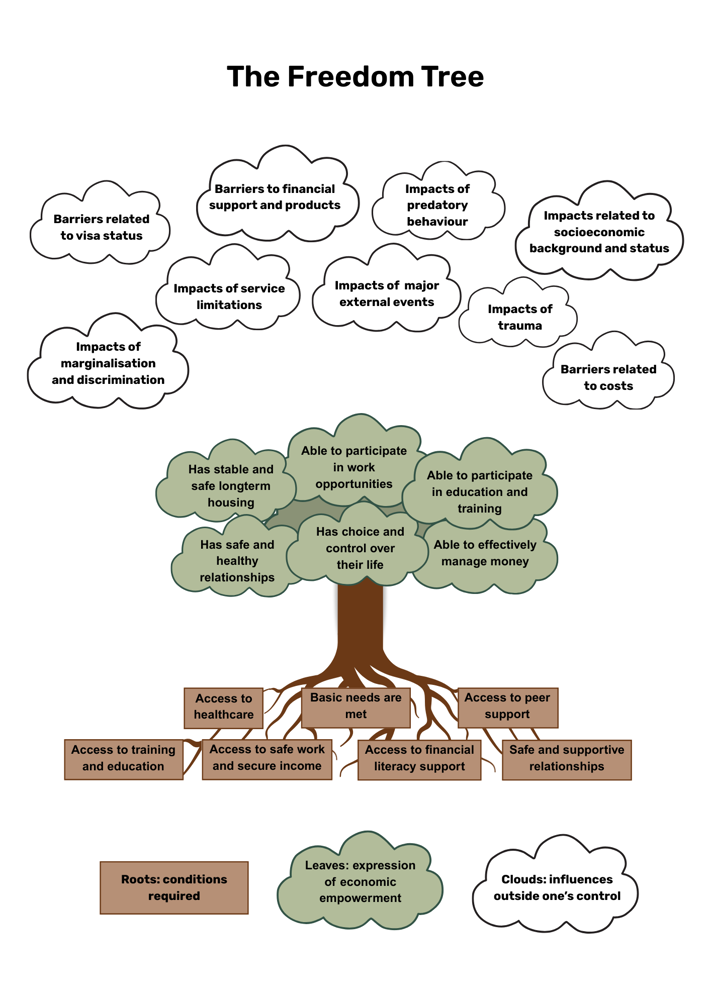
This model brings together survivor knowledge in a practical way providing an evidence base that can inform future prevention work, including Australia’s next National Action Plan to Combat Modern Slavery.
Participants also shared strong feedback about the process.
Many said they felt:
-
Respected enough to share their insight
-
Their opinions were valued
-
Supported - there was a good support system in place
-
Paid fairly for their time and expertise.
This was according to a survey we conducted at the end of the project.
What this means for other organisations
Engaging lived experience well takes:
-
Time - understanding survivors needs and their capacity to engage
-
Proper resources
-
Trust - creating rapport and build an environment for survivors to feel safe enough to engage
-
Real partnership - when there is real power sharing
When this is done properly, the results are much stronger. The work is grounded in reality, shaped by real expertise with outcomes that actually reflect people’s real lives.
If your organisation wants to embed lived experience properly, do not do it alone.
Work with survivor-led organisations.
Use existing frameworks.
Reimburse them fairly.
Build trauma-safe systems first.
Final reflection
This project reinforced something I strongly believe - lived experience does not strengthen work because of personal stories alone. It strengthens work because it brings reality into systems that are often designed far away from people’s lives.
When lived expertise is embedded early, paid fairly, and supported properly, it leads to stronger evidence and more ethical outcomes.
Looking to embed lived experience safely and professionally?
Fair Futures can support you to design ethical, trauma-aware, and practical engagement approaches that go beyond consultation and lead to real impact. Contact us to learn more.

