Beyond emissions: Why it's time for companies to report on social risk and inequality
Fiona David
We expect companies to report on their greenhouse gas emissions. But not their impacts or dependencies on people. This needs to change.
Whether the issue is companies failing to pay workers a living wage, or the threat that rising inequality poses to community support for the energy transition, these are not abstract future problems. They are with us now, and can pose material risks to people, communities, companies and investors.

Business case for a focus on people-related disclosures
Businesses depend on people, as customers, as workers, as engaged team members who develop intellectual property or build relationships and manage teams.
But as inequality rises, the strains on people are rising exponentially. These flow from:
- The wealth gap: The richest 10% of people hold about 74% of total global wealth, while the poorest 50% own less than 5 percent (G20, 2025).
- Wages not meeting living costs: Globally, one billion people, or around ⅓ of the global workforce, do not earn enough to afford a decent living (Business Commission to Tackle Inequality, 2023). In plain terms, this means there are a billion people who are working, but they do not earn enough to meet their basic needs like housing, healthcare, and education for their children.
But what do these system-level conditions have to do with businesses and investors?
One clear impact is the connection between rising inequality, increased polarisation and declining support for the energy transition.
A recent G20 report on inequality, led by renowned economist and Nobel-Laureate Joseph Stiglitz, noted that:
"Inequality causes people’s lives to be more fragile, leading to perceptions of unfairness that spark frustration and resentment. That, in turn, undermines social and political cohesion, eroding citizens’ trust in authorities and institutions. The consequences are political instability, decreased confidence in democracy, enhanced conflicts and diminished appetite for international cooperation. Inequality also affects our ability to deal with planetary challenges." (G20, 2025)
For anyone concerned about climate transition, the implications are clear - greater headwinds to achieve a smooth energy transition, greater resistance and frankly, greater chance of conflict.
Inequality also creates the conditions that enable serious human rights abuses, such as forced labour, to occur. Along with the human cost, these situations present a risk for any business with supply chains in affected economies. Precarious living and working conditions make people highly vulnerable to exploitation, a risk compounding daily as conflict and climate change push more communities to the margins.
The numbers of people in precarious working and living conditions are rising. For instance, in the past decade, weather related disasters have caused 250m internal displacements worldwide, more than 67,000 per day (UNHCR, 2025). Migrant workers experience forced labour at far higher rates than other workers, partly because of local restrictions and discrimination, that limit migrants to work in poorly regulated sectors. Today, around 2.1 billion workers, or nearly 60% of the global workforce, are in informal (unregulated, unprotected) employment (ILO, 2026).
Impacts on investors
For investors, inequality undermines the stability and macro-conditions that enable long-term returns on portfolios. Where risks affect the market as a whole, investors cannot easily diversify away from inequality risks. As noted in the Beta Framework, even when individual companies may be performing well, system-level risks can depress returns across portfolios.
About the Taskforce on Inequality and Social-related Financial Disclosures
Just as businesses and investors need a common language to talk about climate-change, they need a common language and framework to talk about people-related risks and impacts.
This is the purpose of the Taskforce on Inequality and Social-related Financial Disclosures (TISFD), which in May 2026 released its Beta Framework for recommended corporate and financial institution disclosures on social risk and inequality.
The idea is that by making these impacts on people more visible, the framework will support better business decision-making, stronger investor insight and clearer accountability to stakeholders.
While very much a first draft, the Beta Framework is a big step forward on a longer journey to help clarify expectations on what social impacts businesses and investors should be incorporating into governance and management systems, and how these should be disclosed to the market.
Core design principles
Drawing on existing standards, the TISFD draft disclosure framework aims to reduce fragmentation and create a more aligned framework that is globally applicable. The framework can be used on its own but it is designed to fill gaps and complement existing standards. Because people, planet and nature are deeply interconnected, TISFD uses the same pillar structure as the TCFD and TNFD. This will enable more integrated reporting.
Conceptual framework
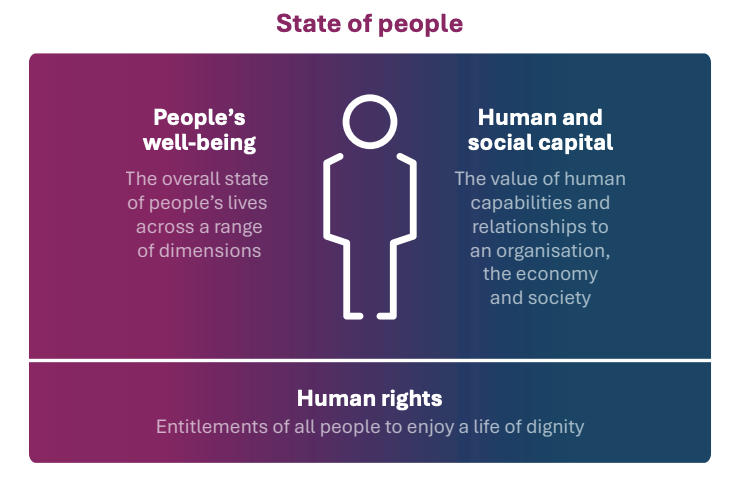
The Framework is built on a conceptual framework that clearly shows how "human rights", "wellbeing" and "human and social capital" are inter-related. For businesses trying to grapple with how the many concepts of DEI, discrimination, human rights and social impact are all impacting their daily work, the Framework is likely to be both practical and useful.
In short, human rights are the minimum expectation - the floor, if you like. Wellbeing is a more expansive concept, that captures the overall state of people's lives. All of this impacts human and social capital - people's ability to create value for business - whether through innovation, or relationships, or simply turning up reliably for work.
Diagram: Interrelated concepts of human rights, wellbeing and human and social capital (TISFD Beta Framework).
Draft Disclosures Framework
The TISFD is not recommending that all people-related issues should be subject to disclosures. Instead, it recommends that organisations should disclose:
- Material information about their people-related impacts. The Beta Framework notes that "what constitutes material information is dependent on the materiality definition applied".
- System-level information, particularly as investor expectations change. For example, failing to pay a living wage can aggregate in income and wealth inequalities that have system wide impacts, with implications for investors.
- Stakeholder engagement, including through due diligence and the assessment of impacts and dependencies.
- Scope of their assessment, recognising that this could include operations and value chains.
- Time-horizons used.
The Disclosures Framework is structured the same way that disclosures are structured under other global frameworks, like the Taskforce on Climate-Related Financial Disclosures. So, for anyone who is familiar with Australia's AASB Sustainability Reporting Standards, the structure will be familiar, organised around disclosures on:
- Governance: What governance is in place for oversight of risks to people?
- Strategy: How is the company's business model interacting with risks to people?
- Impact and risk management: What are the processes the business is using to identify, assess, prioritise and monitor people-related impacts, dependencies, risks and opportunities?
- Metrics and targets: What is the company actually tracking to understand impacts on people?
Measuring inequality and social risk
The Beta-Framework has not yet tackled the issue of specific metrics and targets, but has instead identified this as a key issue to focus on going forward.
While many companies are familiar with the steps needed to measure and track greenhouse gas emissions, fewer are familiar with the frameworks on inequality and social risk. However, measurement of inequality and social risk is both possible and well established. For example:
- Inequality: The Gini Co-efficient is a widely accepted, readily available metric of income inequality within a country (eg: World Bank Gini Index, OECD Inequality Index).
- Living wage: Data on the gap between minimum wage and living wage is increasingly available for many countries and even sub-national regions, particularly in emerging economies (Global Living Wage Coalition).
Opportunity to contribute to developing the framework
The Beta Framework is a draft and is open for comment until 30 July 2026. You can provide feedback here.
In July, as part of the TISFD Regional Council, Asia Pacific, I'll be providing briefings on the framework to major multi-stakeholder groups of investors and businesses.
I'm looking forward to playing my part in helping socialise the framework to businesses and investors in Australia.
Reach out if you would like to know more
References:
Business Commission to Tackle Inequality, Tackling Inequality: An Agenda for Business Action, 2023, link here.
G20 Extraordinary Committee of Independent Experts on Global Inequality, November 2025, link here.
ILO, Employment and Social trends 2026, link here.
Lancet report in collaboration with the World Health Organization. Romanello, M, et al, 2025, The 2025 report of the Lancet Countdown on Health and Climate Change: Climate change action offers a lifeline. The Lancet, 406 (10521), 2804-2857, link here.
TISFD, Beta Framework 0.1, The TISFD Framework Recommendations for disclosure of people-related information by businesses and financial institutions, link here.
UNHCR, 2025, No Escape II: The way forward: Bringing Climate Solutions to the Frontlines of Displacement and Conflict, link here.
